
Pradeep Ramteke
Editor-in-Chief
The epoch-making Dr. Babasaheb Ambedkar was, in essence, a veritable abode of knowledge! Having acquired boundless wisdom, he was a profound scholar of every conceivable subject. Whenever scholars of any stature engaged in a discussion with him on any topic, they invariably found themselves falling short in comparison.
This underscores the fact that Dr. Babasaheb Ambedkar possessed a deep and profound understanding of Indian culture, every religion practiced in India and their respective customs, every caste and sect, the oppressive Varna (caste) system enshrined in the Manusmriti, economic currency and systems, the plight of farmers, the mechanisms of exploitation faced by indigenous men and women, and—crucially—the mindset that perpetrated injustice and atrocities against indigenous Indians (both men and women), seeking to reduce them to servitude.
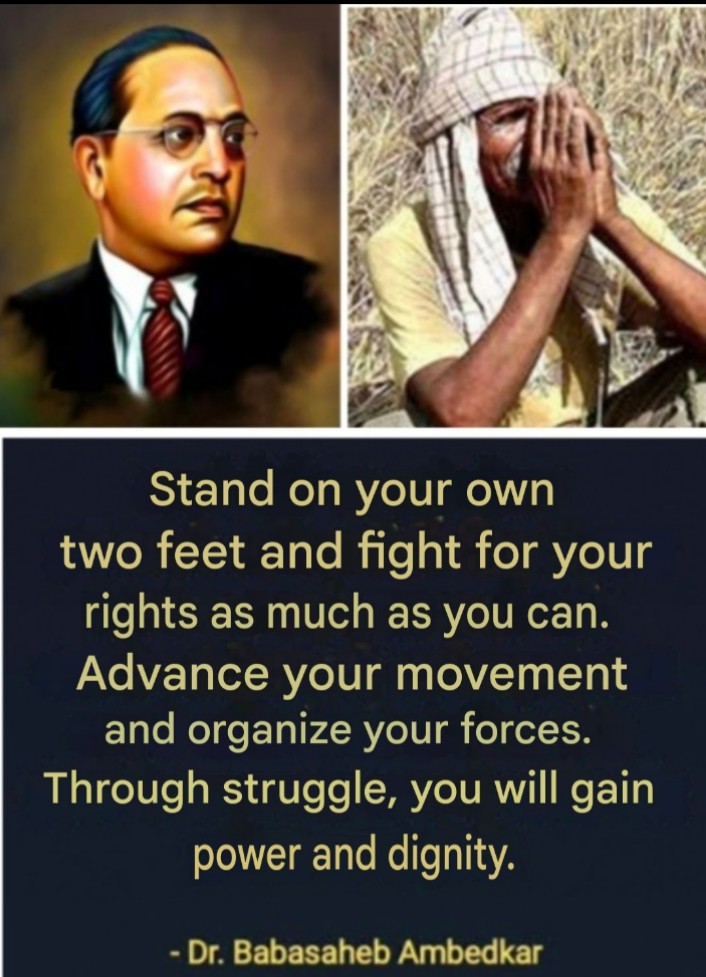
It was precisely for this reason that he unequivocally asserted: “If the farmer is happy, the nation is happy.” Consequently, he warned that if agrarian issues are not identified in a timely manner—and if immediate remedial measures are not implemented—the agricultural sector of the nation would inevitably enter a “danger zone.” Dr. Babasaheb Ambedkar made this prophetic prediction nearly a century ago.
Thus, in celebrating the monumental legacy of the great Dr. Babasaheb Ambedkar, a multitude of epithets are employed to describe him: Doctor, Legal Luminary, Economist, Master Politician, Professor, Principal, Philosopher, Architect of the Indian Constitution, Great Patriot, Labor Leader, Journalist, Editor, Epoch-Maker (Yugnayak), Voice of the Voiceless (Mooknayak), Parliamentarian, Educationist, Social Reformer, Bharat Ratna (Jewel of India), and Vishwa Ratna (Jewel of the World). Even today, in an agrarian nation like India, many remain unaware of the identity of the epoch-making Dr. Babasaheb—recognized as a ‘Leader of Farmers’—and the work he undertook to safeguard their interests.
Dr. Babasaheb Ambedkar, who famously asserted, “If the farmer is happy, the nation is happy,”—what exactly did he do for farmers? And what guidance did he offer regarding their welfare? It is imperative that both the current generation of farmers and those to follow understand this. They must truly comprehend and recognize Dr. Babasaheb Ambedkar as the visionary leader of farmers that he was.
A visionary far ahead of his time, Dr. Babasaheb Ambedkar—a true man of the era—authored the book Small Holdings in India and Their Remedies in 1918—a full century ago—in which he outlined the problems plaguing agriculture and proposed solutions. Within its pages, Dr. Babasaheb Ambedkar conveyed numerous crucial insights to the farming community.
A hundred years ago—long before the reality unfolded—Dr. Babasaheb Ambedkar predicted that the continuous fragmentation of agricultural land—driven by generational succession and the expansion of joint families—would eventually result in farmers becoming marginal landholders in the future.
Farmers whose ancestors once possessed hundreds of acres of land are today left with mere fragments—barely enough to sustain themselves. They have, in fact, become marginal farmers. This very outcome—that such a situation would arise in the future—is precisely what Dr. Babasaheb Ambedkar had foretold a century ago.
As a remedy to this predicament, Dr. Babasaheb—the architect of modern India—advised: “Engage only one of your children in farming. Guide your other children toward careers in industry, trade, education, or the service sector.” By doing so, the economic burden of livelihood placed upon agriculture would be alleviated, the need for land fragmentation would be eliminated, and your entire family would no longer remain solely dependent on farming for its survival.
Today, we witness farmers voicing their grievances: “We toil in the fields, yet we see no progress. If a drought strikes, we are left with absolutely nothing to eat. We are driven to the brink of suicide. Under such circumstances, how are we supposed to educate our children?” This issue looms large and starkly before farmers in the present day.
The very first march that the economist Dr. Babasaheb Ambedkar led to the Legislature was not representative of any single caste or religion, nor was it exclusively for the ‘untouchables’; rather, it was a march of farmers—organized specifically to address farmers’ issues and to secure justice for them. Farmers and their children today must recognize Dr. Babasaheb Ambedkar in this light: as a true leader of farmers.
It was precisely due to this foresight that Dr. Babasaheb Ambedkar advocated, even back then, that while one child should remain in agriculture, the second child should be directed toward industry, trade, education, or the service sector—either by securing a job or by venturing into business. From these avenues, you would derive a regular, assured, and steady financial income.
Had we truly grasped the vision of a man as prescient as Dr. Babasaheb Ambedkar, agricultural land would not have undergone such excessive fragmentation and subdivision, and farmers would not have been reduced to the plight of being marginal landholders.
Numerous farmers’ organizations, individual farmers, and political parties stage protests demanding a Minimum Support Price (MSP) or a fair market rate for agricultural produce. Because they fail to secure a proper market price, farmers are often compelled to sell their crops at dirt-cheap rates—sometimes, in extreme instances, they are even forced to discard their produce onto the streets.
The underlying reason is that selling their produce becomes economically unviable, as the produce fails to fetch a fair price. It was precisely to address this issue that, nearly a century ago, Dr. Babasaheb Ambedkar propounded the concept that agricultural produce must be accorded a fair market price and a guaranteed rate—a rate that should be determined based on the actual cost of production.
The counsel that Dr. Babasaheb Ambedkar offered to the Government of India holds immense significance. Just as other production-oriented systems are accorded the status of ‘industry’ or ‘manufacturing,’ agriculture, too, must be granted the status of both an industry and a sector deserving of infrastructural support, such as irrigation.
Dr. Babasaheb Ambedkar firmly believed that if agriculture were to be accorded the status of an industry, farmers would be empowered to carve out a distinct and dignified niche for themselves within the national economy as entrepreneurs. In 1929, Dr. Babasaheb Ambedkar organized a Farmers’ Conference. The citizens of the country are well aware of Babasaheb’s political and social stance; however—beyond his struggle for the untouchables and his constitutional work—Dr. Babasaheb Ambedkar had also convened a conference specifically for farmers.
The work and role of Dr. Babasaheb Ambedkar—the architect of modern India—have either failed to reach the masses, or neither the Government of India, the various state governments, nor the farmers themselves (including their leaders) have made a sincere effort to understand them.
Dr. Babasaheb Ambedkar organized a ‘Farmers’ Conference’ specifically to articulate the diverse issues facing farmers, to facilitate discussions on their concerns, and to ensure that the voice of the farming community reached the British government. Furthermore, the very first protest march that Dr. Babasaheb Ambedkar led in his lifetime—on January 10, 1938, to the Legislative Assembly—was not undertaken on behalf of any single caste, religion, or specific group such as Dalits or ‘Untouchables’; rather, that historic first march led by Dr. Babasaheb Ambedkar to the legislature was a march for the farmers.
His demands included the abolition of the Khoti system (a feudal land tenure system), an end to the exploitation of farmers, the provision of adequate water for agriculture, and the enactment of laws that served the best interests of the farming community. Dr. Babasaheb Ambedkar also authored articles addressing the specific manner in which land revenue ought to be levied upon farmers, and he held the government accountable for its policies.
On August 18, 1925, Dr. Babasaheb Ambedkar penned an article on the agrarian crisis. In this piece, he articulated a scathing reality: that levying land revenue based merely on an estimate of net income—and the practice of indiscriminately collecting exorbitant land taxes from farmers—was unjust, inequitable, and constituted a blatant exploitation of the farming community.
When Dr. Babasaheb Ambedkar entered the Mumbai Legislative Assembly, the very first speech he delivered was not one advocating for justice for specific castes or religions, nor was it focused on articulating their particular grievances; rather, that inaugural speech was dedicated entirely to the issues facing farmers, demanding that justice be served to the agricultural community. This fact is something that everyone ought to remember. The individual who performs the actual physical labor and cultivation in agriculture must reap the rewards of their toil. The practice whereby *Khot*s and Inamdars—acting like middlemen—skim off the cream of the farmers’ hard work must cease. A law should be enacted to ensure that hardworking farmers receive a minimum wage. Dr. Babasaheb Ambedkar put forth numerous demands in the legislature aimed at the welfare of farmers, including the waiver of outstanding land revenue and the provision of a fair guaranteed price for agricultural produce.
Subsequently, during his tenure as India’s first Minister of Irrigation and Power, if Dr. Babasaheb Ambedkar accorded top priority to any specific cause, it was undoubtedly to the interests of the farmers.
On May 15, 1950, Dr. Babasaheb Ambedkar enacted the Khot Abolition Act. The impact of this legislation was profound: 122,860 acres of land were liberated from the clutches of Khots and Inamdars and were subsequently transferred to the hardworking farmers who actually tilled the soil. Consequently, farmers became the rightful owners of the agricultural land they cultivated and began to reap the full benefits of their labor.
Furthermore, while holding the portfolio of Irrigation and Power, Dr. Babasaheb Ambedkar implemented pivotal policies for the nation—and specifically for its agricultural sector. His vision centered on how to ensure the welfare of every single farmer in the country, how to ensure that food grains reached every household, and how to enable every farmer to attain economic prosperity. With this perspective in mind, Babasaheb formulated the objectives of the water policy. Furthermore, Dr. Babasaheb Ambedkar asserted that agriculture is the fundamental occupation upon which all other industries and enterprises in this country depend. Therefore, to ensure the smooth functioning of all industries and to foster national progress, the primary sector that supplies them with raw materials—namely, agriculture—must itself operate efficiently. To this end, agriculture must be provided with all necessary amenities and essential resources; among these, water is of paramount importance. Dr. Babasaheb Ambedkar’s policy, therefore, emphasized that agriculture must receive an abundant and assured supply of water.
During his tenure as the Minister of Irrigation, he took the bold decision to initiate the Damodar Valley Project in this country. Dr. Babasaheb Ambedkar articulated the vision—as early as the 1940s—that just as other production-oriented systems are accorded the status of ‘industry’ or ‘manufacturing,’ agriculture, too, should be granted the status of an industry, complete with the necessary infrastructure for irrigation.
Concurrently, under the leadership of Dr. Babasaheb Ambedkar—then serving as the Union Minister of Irrigation—dams were constructed across the Mahanadi River at sites such as Tikarpara, Hirakud, Sonanadi, and Niraj. Additionally, Babasaheb successfully resolved various inter-governmental disputes involving Hyderabad and Madras. Consequently, under his leadership as the Minister of Irrigation and Power, numerous water policies were formulated, and a multitude of projects—including the Tungabhadra Dam, the Chambal River Project, various small and large-scale projects across Southern India, and several water schemes in the state of Punjab—were initiated and brought to fruition.
As a result, agriculture across the entire nation received a renewed impetus. Agricultural production witnessed a significant surge; farmers attained prosperity; they secured their rightful entitlements, legal rights, and their due share of water; and the land itself was transformed into lush, verdant fields. Through his scholarly policies, meticulous water planning, and the pivotal decisions made during his tenure as Minister of Irrigation, Dr. Babasaheb Ambedkar laid the very foundation of water development in India. Dr. Babasaheb Ambedkar stands as the true ‘Water Hero’—a visionary leader who, with foresight extending far into the future, established the bedrock of India’s water policies.
In our country, across numerous states and regions, severe droughts strike with alarming regularity—typically occurring every two or three years. Deprived of water, agricultural lands turn barren; farmers face utter ruin, livestock perish, and the farming community suffers immense financial losses. It takes farmers another three to four years just to recover from this economic devastation, only for yet another drought to loom before them once again.
A century ago, the legendary Dr. Babasaheb Ambedkar contemplated this very issue of recurring droughts. While serving as the Minister of Irrigation, Dr. Ambedkar proposed the ‘River-Linking Project,’ asserting that a permanent solution must be devised to mitigate the catastrophic natural calamities that befall farmers whenever a drought strikes The rivers that originate in the Himalayas carry snow, which melts during the summer due to the heat. Consequently, these rivers experience flooding in those regions during the summer months. If, through a river-linking project, these rivers were connected to those in drought-prone areas, the floodwaters generated during the summer could be diverted to these arid regions, thereby eradicating drought. This would prevent damage to agriculture and save the farmer. Dr. Babasaheb Ambedkar, speaking a century ago, asserted that this would ensure farmers suffer no financial loss and would never be driven to the point of committing suicide. We must recognize and understand Dr. Babasaheb Ambedkar as a true leader of farmers—one who genuinely prioritized their welfare.
While addressing these issues and proposing solutions, Dr. Babasaheb Ambedkar famously stated: “If the farmer is happy, the nation is happy.” He predicted—a century ago—that if these agricultural problems were not identified in a timely manner and addressed with immediate remedial measures, the country’s agriculture and its farmers would enter a “danger zone.”
If we reflect today on the precise state of agriculture—and ponder why farmers are being compelled to commit suicide—we realize just how profoundly significant were the solutions Dr. Babasaheb Ambedkar proposed alongside his diagnosis of agricultural problems. Had the Government of India and the various state governments implemented those measures, farmers would not be facing this dire situation today. This truth is now becoming evident to the children of farmers across the country.
Therefore, every farmer’s child must look beyond the confines of caste and religion to truly understand Dr. Babasaheb Ambedkar—the advocate, the champion, and the leader of farmers who placed their welfare above all else. While articulating his stance on agrarian issues—with a keen eye on the welfare of farmers and the adversities they face—Dr. Babasaheb Ambedkar took into consideration *all* the farmers of this nation: their families, and the future of their children. This fact must be recognized and appreciated by the present generation. Furthermore, today’s new generation needs to understand that Dr. Babasaheb Ambedkar was, in fact, the true champion and leader of the farmers.
Today, many farmers—and their children—hold the misconception that Dr. Babasaheb Ambedkar was merely a leader of the ‘Untouchables’ (Dalits): someone who concerned himself solely with their welfare, fought exclusively for their cause, and worked only to secure their rights and entitlements within this country.
However, everyone must realize that Dr. Babasaheb Ambedkar was, first and foremost, a leader of the farmers—one who prioritized the welfare of all farmers in this country, even before addressing the issues of the Untouchables. He raised his voice for the interests of all farmers within the legislature, led protest marches to the legislative assembly, and, during his tenure as a Union Minister, took decisive actions to safeguard agrarian interests.
If today’s farmers—and their children—were to truly understand Dr. Babasaheb Ambedkar’s legacy, they would undoubtedly discover the pathways to address their current challenges: identifying which pro-farmer laws to demand from the present government, determining how to ensure their enactment, recognizing which welfare schemes need to be implemented for their benefit, and learning how to effectively raise their collective voice to achieve these goals.
Consequently, everyone—including the farmers themselves—would come to realize the immense significance of Dr. Babasaheb Ambedkar’s work for agrarian welfare, and the profound, far-reaching impact his contributions as a national leader of farmers have had—and continue to have—on the country’s agricultural system and its overall economy.