

Pradeep Ramteke
Editor-in-Chief
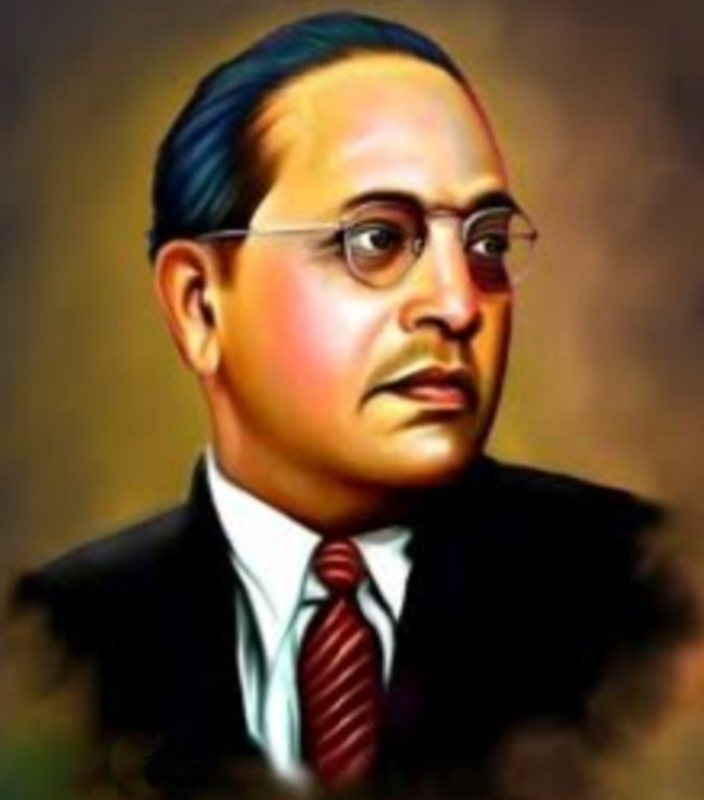
There is virtually no sphere in India to which Dr. Babasaheb Ambedkar has not contributed. The subject of Dr. Babasaheb Ambedkar is not confined merely to the boundaries of caste, religion, sect, or region; rather, Dr. Babasaheb Ambedkar—the architect of modern India and a ‘Global Gem’ (Vishwratna)—has emerged as the very embodiment of India’s global identity.
When one examines the entire life and achievements of the legendary Dr. Babasaheb Ambedkar, one fact becomes abundantly clear: throughout his entire life, he openly challenged and opposed those erroneous customs, traditions, and practices—those social norms—that serve to deny human beings their inherent dignity and humanity.
In this same vein, the book that denies human dignity, propagates inequality and discrimination, and strips both men and women of their fundamental rights and entitlements is the Manusmriti. Dr. Babasaheb Ambedkar not only rejects this discriminatory and rights-denying text—the Manusmriti—but goes a step further: he publicly burns it.
Consider this: when one of the world’s greatest bibliophiles—a profound thinker and voracious reader—publicly burns a book like the Manusmriti, just how toxic must that book truly be? Throughout his life, Dr. Babasaheb Ambedkar openly rejected numerous such things, and in doing so, he invariably provided a clear and cogent explanation as to why he rejected them. If one examines and reflects upon the entirety of Dr. Babasaheb Ambedkar’s struggle with a scholarly perspective, the most significant lesson for the present generation to draw from it is this: one must possess the ability to stand up fearlessly, with immense courage and unwavering resolve, against injustice and wrongdoing. You must possess the moral courage to call a wrong a wrong, and to appreciate that which is right and good.
Otherwise, in this day and age—driven by self-interest or fear—people often end up encouraging wrongful acts; instead of opposing injustice, they are frequently seen turning a blind eye to it. Consequently, society as a whole suffers immense harm. Therefore, everyone who invokes the names of great historical figures must cultivate the courage to call out injustice for what it is.
One hundred years ago, Dr. Babasaheb Ambedkar possessed the courage to boldly and unequivocally assert that the Manusmriti was flawed. Yet today, a century later, many still lack that very courage. Dr. Babasaheb Ambedkar was a valiant warrior who articulated his stance with absolute clarity, refusing to succumb to any form of pressure!
The second crucial lesson to be learned from the actions of the erudite scholar Dr. Babasaheb Ambedkar is this: the Bodhisattva Dr. Babasaheb Ambedkar never opposed anything without first subjecting it to rigorous study. To understand why the Manusmriti was objectionable, Babasaheb undertook a thorough study of the text itself. Moreover, the language of many ancient texts was—and is—Sanskrit! Dr. Babasaheb Ambedkar was initially denied permission to learn Sanskrit. However, through immense effort and rigorous self-study, he mastered the language; he was subsequently able to write, read, and comprehend Sanskrit of the highest caliber.
Dr. Babasaheb Ambedkar undertook a thorough study of the Manusmriti and ultimately rejected it, asserting that it did not serve the public good, that it sowed the seeds of caste-based inequality, and that it denied women their fundamental human dignity. In this context, one must take note of the scholarly temperament and intellectual depth of the ‘Sun of Wisdom,’ Dr. Babasaheb Ambedkar.
For young people aspiring to enter politics—particularly those lacking a political lineage, financial resources, or opportunities from established parties—Dr. Babasaheb Ambedkar stands as the true ‘Political Idol.’ He was a political titan who built his own political identity from scratch and dared to challenge the Congress party—which then held a near-monopoly on national power—directly in Delhi.
Even today, whenever we undertake a task, oppose an idea, or offer criticism, it is imperative to first conduct a deep and comprehensive study of its merits and demerits. Society is rife with individuals who, possessing only superficial knowledge, presume themselves to be experts.
Instead of acting in such a manner, we must learn from Dr. Babasaheb Ambedkar the principle that one should offer commentary on any subject only after having undertaken a complete and thorough study of it.
A third lesson that everyone should draw from these instances is that Dr. Babasaheb Ambedkar never opposed something merely for the sake of opposition. He never engaged in the cynical tactics of opposing simply to stir up controversy, disrupt social harmony, serve personal self-interest, and then abandon the issue entirely; such conduct was utterly alien to Dr. Babasaheb Ambedkar’s way of life. Dr. Babasaheb Ambedkar—a global icon—firmly opposes whatever he deems objectionable. A crucial point to note here is that for every issue he opposes, Babasaheb himself constructs new alternatives that serve the best interests of both the nation and humanity. This is a matter of profound significance.
When we reject or critique something, we must also be able to articulate what constitutes a better alternative and what viable options exist to replace that flawed or detrimental element. The epoch-making Dr. Babasaheb Ambedkar, throughout his life, did precisely this: for every concept or practice he rejected, he himself stood forth as the alternative—he personally created the substitute. To achieve this, he staked his very life, toiled day and night, and strove relentlessly; yet, in the end, he successfully established robust and effective alternatives. This is of paramount importance.
The thoughts of Dr. Babasaheb Ambedkar—who emerged as a world-class economist of great stature—serve as an inspiration not only for India but for the entire globe. His political policies were firmly rooted in his economic and social perspectives. Consequently, his philosophy was both scientific and humanistic in nature. It is precisely for this reason, according to Major General Thanakas Pumpetch of Thailand, that he embraced the Buddhist faith.
From New York in the United States to York University in Canada, the profound influence of Dr. Babasaheb Ambedkar’s knowledge and ideas is clearly evident in the twenty-first century; this is, indeed, a matter of immense pride and joy for all Indians. Even in Canada—a nation where Dr. Babasaheb Ambedkar (the ‘Mooknayak’ or ‘Voice of the Voiceless’) never actually went to study—the ‘Suryajnan’ (Sun of Knowledge) that is Dr. Babasaheb Ambedkar is regarded as a guiding light for future generations.
Dr. Babasaheb Ambedkar is a source of inspiration not merely for Indians, but for the entire world. Wherever injustice and oppression prevail across the globe, Dr. Babasaheb Ambedkar stands as a source of strength and inspiration for those exploited and marginalized communities.
Similarly, at the University of Melbourne—Australia’s premier institution, established in the eighteenth century and recognized as a national university—Dr. Babasaheb Ambedkar consistently serves as a guide and a source of inspiration for thousands of students.
The students who arrive at Columbia University from various nations across the world to pursue their studies represent the future architects of the global landscape; they are the world’s leading thinkers—the top-tier scholars and intellectuals from their respective countries who will return home to shape the destiny of their nations. It is these very students—the key global figures poised to transform the world of tomorrow—who are required to study the autobiography of Dr. Babasaheb Ambedkar as a means of proving their own intellectual mettle. In light of Dr. Babasaheb Ambedkar’s monumental contributions across all fields, Nobel Laureate—and renowned economist, sociologist, and political scientist—Gunnar Myrdal observed: “Dr. Babasaheb Ambedkar will be remembered by the entire world as a great Indian who charted the course for independent India for generations to come!”
On April 12, 1990, former South African President Nelson Mandela stated: “Drawing inspiration from the life and work of Dr. Babasaheb Ambedkar, our own struggle is being waged on the very same foundations—the foundations upon which Dr. Babasaheb Ambedkar strove for social transformation and achieved success.”
Consequently, the statues of Dr. Babasaheb Ambedkar erected across the globe stand as enduring testaments to his achievements and serve as a source of inspiration for a new era.
Vishwratna (Jewel of the World) Dr. Babasaheb Ambedkar once warned: “If any political party prioritizes its own ideology over the nation itself, it is inevitable that such a party will place the freedom of the Indian people in jeopardy once again; indeed, that very party may well be the one to extinguish Indian liberty forever!”
Therefore, every man and woman in India must pay heed to this profound statement by Dr. Babasaheb Ambedkar, for a grave peril—akin to the dark specter of subjugation—is currently being cast upon the nation by certain political parties.