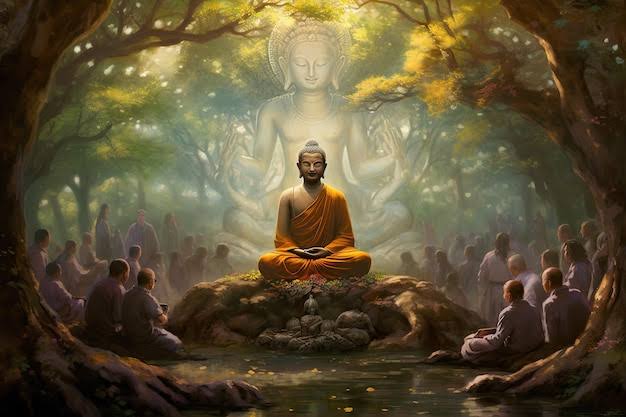
The one who gave the Aryan message of happiness-peace-humanity and freedom from suffering to the entire world, the guide to freedom from suffering, the great man free from all suffering, whose mind was as calm, serious, clever and spotless as the cool moon of a full moon, the creator of world peace, the messenger of world peace, the world-worshipper, the Tathagata, the Lord Samyak Sambuddha…!
Happy birthday to him on the occasion of his 2569th birthday…!!
Buddha Jayanti-Buddha Pournima-Vaisakh Pournima…
Birth, attainment of enlightenment and Mahaparinirvana.. The day on which all these three historical events in the life of the Tathagata took place is Vaisakh Pournima.
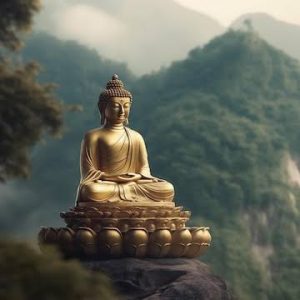 Today is the day. On May 12, 2025, like every year, all over the world (i.e. in about 180 countries), the 2569th Buddha Purnima is being celebrated with great pomp and show by followers of Buddha all over the world, considering the thoughts of Buddha as the standard. This Purnima falls in the month of May. This is the most important Purnima for the followers of Buddhism. This Purnima is called the Triple Holy Purnima.
On this Purnima, Bodhisattva Siddhartha Gautama was born to Mahamaya and King Suddhodana under the Shawl tree in the Lumbini forest.
Mahamaya was going to her father’s house in a palanquin with great pomp and show to give birth. While going to the beautiful and picturesque Lumbini forest, Mahamaya felt the desire to stay there for some time. While stopping in this forest, holding a branch of a Shawl tree in her hand, she gave birth to the baby while standing.
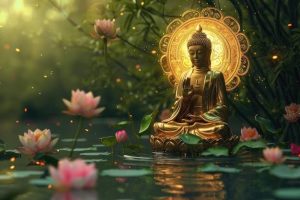 Dr. Babasaheb Ambedkar has described the birth of Siddhartha Gautama very beautifully in his book “Lord Buddha and His Dhamma”. He writes: “Mahamaya carried the Bodhisattva in her womb for ten months like oil in a vessel. As her time of delivery approached, she expressed her desire to go to her mother’s house for delivery. She said to her husband, “I want to go to my father’s city of Devadaha.” “It will be as you wish.” The king replied.
“Shuddhodana sent her to her father’s house with great pomp and show, placing her in a golden palanquin. On the way to Devadaha, Mahamaya had to pass through a delightful dark forest of trees blooming with flowers. That was the Lumbini forest.
As the palanquin was being carried through the Lumbini forest, the forest looked like a dreamlike forest of creepers or a pavilion decorated to welcome a great king. The trees there were covered with flowers from the base to the top of their branches. On it, countless colorful butterflies were humming in a picturesque voice.
 And various types of birds were making melodious sounds. Seeing the beautiful scene there, Mahamaya felt a desire to stop there and play for some time. So she asked the servant carrying the palanquin to take his palanquin under the shal tree and stop there.
Mahamaya got down from the palanquin and walked to the base of a beautiful shal tree there. Seeing the branches of that shal tree swaying up and down in the breeze, Mahamaya felt like holding one of them with her hand.
Fortunately, a branch came down easily enough for her to hold. In the meantime, she stood on her toes and held the branch with her hand. At that moment, as the branch rose, Mahamaya was lifted up with a jerk, and due to this shaking, she began to feel the pains of labor.
She gave birth to a son while standing while holding a branch of a tree. The son was born on the full moon of Vaishakh in the year 563 BC.
Shuddhodana and Mahamaya had been married for many years. But they had no children. And so when a son was born, Shuddhodana and his family and all the Shakyas celebrated the birth of a son with great joy and pomp.
At the time of the birth of a son, it was Shuddhodana’s turn to assume the throne of Kapilavastu. Of course, because of this, the child began to be called the Crown Prince. On this same full moon of Vaishakh, Siddhartha Gautama became a Buddha at the age of 35 while sitting under a pipal tree in the Uruvela forest on the banks of the Niranjana river in Gaya. Siddhartha Gautama attained the knowledge of the third stage of liberation from suffering on the night of the full moon of Vaishakh. The darkness in his mind was completely dispelled and he became truly enlightened. On this day, Siddhartha Gautama realized the Four Noble Truths.
In his book “Lord Buddha and His Dhamma”, Dr. Babasaheb Ambedkar has given a detailed explanation of the process of Siddhartha Gautama becoming a Buddha.
On this full moon day, in 483 BC, at the age of 80, under a shawl tree in Kushinara, the capital of the Malla Republic, on the night of this full moon, the Buddha attained Mahaparinirvana while practicing Samadhi in the conscious state of the third watch of the mind.
In the life of Buddha, all three events, birth, attainment of Buddhahood and Mahaparinirvana, took place on the day of Vaishakh full moon. These are very rare events in nature. Since these three events took place on Vaishakh full moon, this full moon is called the Triple Holy Full Moon.
This is a very important festival and should be celebrated with joy and enthusiasm. Everyone should clean their house, decorate it, distribute sweets to others, invite friends and relatives to their house. New clothes should be made for children.The most important thing is that the eight precepts should be followed on this triple holy full moon day. All Buddhist monasteries and Dhamma training institutions should organize Dhamma programs. The monasteries should be decorated. Dhamma discourses should be organized and the minds should be filled with enthusiasm and joy.
Festivals are celebrated to preserve the memory of the events that happened in the past that encourage us to live a happy, prosperous and joyful life on the days of festivals.
Festivals are celebrated to learn from the events of the past on the days of festivals and build our own lives accordingly.
The Buddha taught the path of morality, concentration and wisdom throughout his life. He taught people to develop compassion and to live a life based on equality, freedom and brotherhood.
Therefore, it is urgent to strictly follow the precepts on every Buddhist festival day and to ensure that our actions of body, speech and mind remain spotless and skillful. On all festivals, everyone’s behavior should be in accordance with the teachings of the Buddha.
On this day, Dhamma discourses, Dhamma workshops should be organized in different parts and people should make a sincere effort to learn the Dhamma, so that they continue to strive for the welfare of themselves and others. All twelve full moons are Buddhist festivals.
Important events in the life of the Buddha took place on full moon days. Each full moon has a different significance in Buddhism. Uposatha, i.e. the eight precepts, should be followed seriously on all these days.
Therefore, it is necessary to understand the historical significance of each full moon.