Pradeep Ramteke
Editor-in-Chief
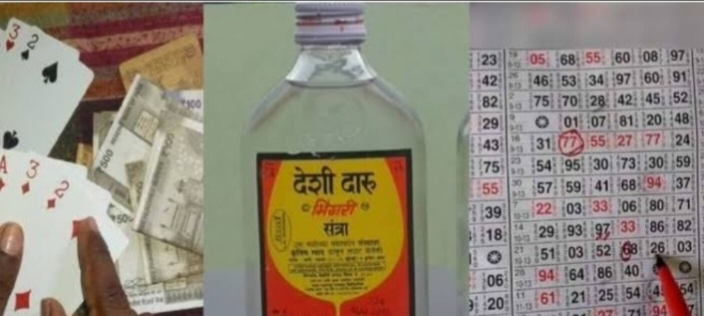
The people of Maharashtra believe that since the concerned Sub-Divisional Police Officers, Senior Police Inspectors, Police Inspectors, Assistant Police Inspectors, Police Sub-Inspectors, Beat Constables, and Police Constables are not paying attention to liquor, gambling, betting, cannabis, charas, and other illegal businesses within Maharashtra state, the Director General of Police and the District Superintendents of Police of each district should now personally pay attention to these illegal businesses in Maharashtra and shut down all types of illegal businesses.
Some Superintendents of Police and police officers are diligent and have a connection with the common citizens.
Therefore, their duty ensures that citizens in urban and rural areas do not become addicted to vices. That is why they do not allow illegal businesses to establish themselves in their jurisdiction or they completely eliminate the illegal business operators.
Because it is a fact that diligent officers do not accept money out of greed through illegal businesses.
Director General of Police….
The Director General of Police (DGP) is the highest-ranking officer of the state police force, and their main duties include maintaining law and order, controlling crime, providing strategic leadership, managing the administration and discipline of the police force, and protecting the rights and safety of citizens, which also includes modernizing the force using technology and protecting the vulnerable sections of society. The main duties of the Director General of Police include providing strategic leadership and setting the vision, objectives, and strategies for the police force, maintaining law and order in the state, and ensuring public safety.
They are also responsible for planning to prevent and control crime, administering the police force, formulating rules, and maintaining discipline.
Furthermore, serving and protecting all sections of society, especially the underprivileged, women, children, and minorities, is also a duty of the Director General of Police.
The Director General of Police acts as the head of the entire police system of the state and has the primary responsibility of keeping the lives of citizens safe.
The DGP is the most senior police officer in a state or union territory. He or she leads the entire police department of that region.
The Director General of Police provides strategic leadership and guidance to the police force, setting the vision, goals, and objectives of the department. They formulate plans and strategies to prevent crime, maintain public order, and protect the rights and welfare of citizens.
Superintendent of Police…
The District Superintendent of Police (SP) is the principal police officer of a district, responsible for maintaining law and order, preventing crime, and leading the police force.
The District Superintendent of Police is the highest-ranking officer of the district police force, and the police force works under their guidance.
Their main job is to maintain law and order, prevent and deter crime, and maintain peace in the district.
Their administrative responsibilities include overseeing the functioning of police stations, appointing personnel, and scheduling security duties. The question…
The question arises: when it is the duty of the state’s Director General of Police, Police Commissioners, Superintendents of Police, Additional Superintendents of Police, Sub-Divisional Police Officers, Senior Police Inspectors, Police Inspectors, Assistant Police Inspectors, and Police Sub-Inspectors to prevent crime, maintain peace and order, and protect society, marginalized sections, women, and children within their respective jurisdictions, these officers do not appear to be living up to their responsibilities.
Therefore, it cannot be denied that illegal businesses are rampant in their areas of operation. The existence of illegal businesses in the state of Maharashtra is an illegal system that is hollowing out society.
Poverty…
Poverty means not having the necessary resources or income to fulfill basic needs such as food, clothing, shelter, health, and education, which prevents a person from living a dignified life and participating fully in society.
Where people below this line are considered poor, they do not have a respectable place in society. Therefore, such people fall prey to the system of addiction and become impoverished repeatedly.
The main characteristics of poverty and the lack of basic needs include not having enough food, not having access to clean water, lack of shelter, inadequate healthcare, and lack of education and employment opportunities.
Such citizens lack sufficient money to buy essential goods and services, lack the opportunities necessary to live a dignified life in society, and are deprived of their rights. Constant economic instability and uncertainty about the future leave poor and impoverished citizens feeling helpless.
Although there are four types of poverty, citizens in all four types of poverty have lower incomes compared to others in society, which prevents them from living an acceptable lifestyle.
Poverty is not just an income problem, but a multidimensional problem connected to many aspects such as health, education, social participation, and opportunities, as stated in sources like Habitat for Humanity and Investopedia.
Poverty reduction, poverty alleviation, or poverty eradication is a set of both economic and humanitarian measures aimed at lifting people out of poverty permanently.
Poverty is a condition or state that indicates a lack of financial resources to meet one’s basic needs or to achieve a standard of living far above basic needs. Four types of poverty are commonly discussed: 1) Absolute, 2) Relative, 3) Situational, and 4) Generational…
Relative poverty means having a lower income compared to the average income and standard of living in society, which makes it difficult for a person to live like other people in society. Even if basic needs are met, the inability to access essential things (such as good education, healthcare, entertainment) compared to other wealthier people in society is called relative poverty. It is based on income inequality.
In relative poverty, a person’s basic needs such as food, clothing, and shelter may be met, but their standard of living is lower compared to others in society. This poverty arises due to income inequality, and the group with lower income is considered poor compared to the higher-income group in society.
Absolute poverty means not having enough income to meet essential needs such as food, clothing, and shelter; it is directly related to a person’s survival. Relative poverty focuses on inequalities in the standard of living within a society, while absolute poverty focuses on the lack of resources necessary for survival.