

Pradeep Ramteke
Editor-in-Chief
According to the new UGC law, students from OBC, SC, ST, minority, and marginalized communities had equal opportunities in higher education…
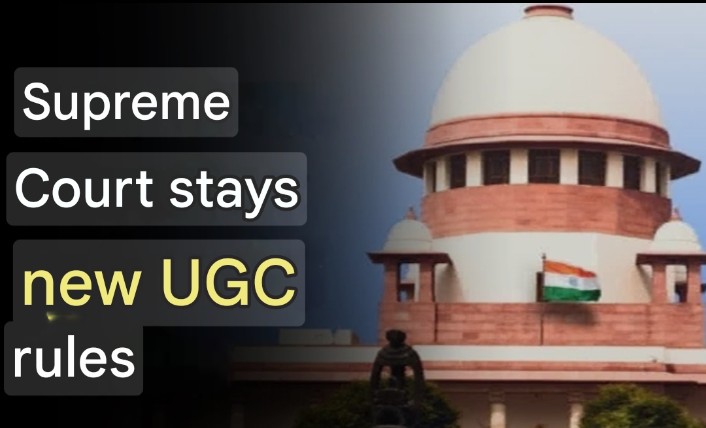
However, it appears that the Supreme Court, along with upper castes, opposed the new UGC law, citing that “it will increase discrimination,” so that students from OBC, SC, ST, minority, and marginalized communities should not receive discrimination-free higher education with proper funding and facilities…
In India, from the time of slavery to the present day, there are over 6,000 castes and over 72,000 sub-castes.
Along with this, customs and traditions that perpetuate discrimination based on caste still exist in India. Even today, upper castes give importance to caste discrimination and the customs and traditions associated with it.
Due to caste discrimination and customs and traditions, a large number of students, young men and women, and men and women from Scheduled Castes and Scheduled Tribes in India are subjected to injustice and atrocities at all levels.
When Indian society is divided into countless castes and sub-castes, how appropriate is it to say that the new UGC law will create division in society?
If the new UGC Act 2026 provides equal opportunities and equal assistance to students from OBC, SC, ST, minority, and marginalized communities, and prevents all types of atrocities and injustices against them, then isn’t the statement of the Chief Justice of the Supreme Court (Suryakant Sharma, Chief Justice of the country), who says that this law creates division and tension in society, unjust to the students of OBC, SC, ST, minority, and marginalized communities? He needs to clarify this…
In industrial, educational, political, social, governmental, and other types of fields. And in the court itself, only 15 percent of upper-caste individuals hold sway. Don’t the upper-caste brothers and the Chief Justice of the country, Suryakant Sharma, see this discrimination? This question arises.
Is it not injustice and oppression to keep the Bahujan community, the indigenous people of India, divided, misguided, ignorant, and constantly deprived of their rights? Who will answer this?
The UGC Act 2026 is one of the most debated educational reforms in India, which sparked controversies, student protests, and legal scrutiny across the country.
But, what is the UGC Act 2026, and why are the new UGC rules 2026 eliciting such strong reactions?
Let’s look at the UGC Bill 2026 and its direct impact on Indian higher education institutions – clearly and factually.
The term UGC Act 2026 refers to the University Grants Commission. It includes promoting equality in higher education institutions.
The rules refer to the 2026 rules, which were officially notified on January 13, 2026. These rules replace the 2012 anti-discrimination guidelines and aim to eliminate caste-based and other forms of discrimination on Indian campuses. The UGC is a statutory body established under the UGC Act, 1956.
The commission’s work is to coordinate higher education, maintain quality standards, and issue UGC guidelines and regulations…
Regulation of universities and colleges in India In simple terms, the UGC is the central body that governs the university education system in India.
What is the UGC Act 2026? It introduces new UGC rules focusing on equality, inclusion, and non-discrimination in higher education institutions.
The main objectives of the UGC Act 2026 are to prevent caste-based discrimination, ensure equal opportunities for Scheduled Castes, Scheduled Tribes, Other Backward Classes, minorities, and marginalized students, and regulate colleges and universities. The aim is to create a system of accountability in universities.
What changed with the new UGC rules of 2026? It was the implementation of new rules by changing the old discriminatory UGC rules.
UGC Rules 2026 means guidelines, legally enforceable rules: 1) Monitoring, Internal Committees, Mandatory, 2) Equity Cells, Complaints, 3) Advisory nature, Timely grievance redressal, 4) Penalties, Limited, Institutional responsibility.
Under this Act, institutions will be established and maintained to provide common facilities, services and programs for groups of universities or for universities in general, or provision will be made for their maintenance by distributing and disbursing grants from the Commission’s funds as the Commission deems fit.
According to the new UGC equity rules, every college and university is mandated to establish a special body called the Equal Opportunity Centre (EOC) on campus. The UGC has asked institutions to set up special committees, helplines and monitoring teams to handle complaints, especially from SC, ST and OBC students.
The 2026 rules came against the backdrop of the pending case of Abeda Salim Tadvi vs. Union of India.
A bench of Justices Surya Kant and Ujjal Bhuyan had directed the UGC to notify new regulations to address caste-based discrimination and student suicides in higher education institutions.
According to the new UGC, 2026 law, rules were also implemented stating that students from OBC, SC, ST, minority, and marginalized communities should not be subjected to injustice or discrimination by “upper-caste institution administrators and students,” and that there should be no discrimination in awarding appropriate marks based on correct answers in mark sheets, or in providing educational grants.