Pradeep Ramteke
Editor-in-Chief
On January 26, 1950, the Constitution of India came into effect, and the country became a republic. Therefore, it is certain that on Monday, January 26, 2026, Republic Day will be celebrated with enthusiasm by the central and state governments, local self-government officials, government and semi-government officers and employees, students, and men and women, youth, unemployed people, laborers, farmers, and citizens of India.
According to the constitutional values of unity, equality, justice, and fraternity, the men and women of India received freedom and freedom of expression, and the right to express themselves.
During the period of subjugation, India was a slave to the British. That is, all the men and women of this country were slaves to the British.
But, another reality is that the then Shudras and Ati-Shudras of this country, who are today’s OBCs, SCs, STs, minorities, and other indigenous Bahujan men and women, were also slaves to the upper castes, namely Brahmins, Baniyas, and Thakurs, according to the laws of Manusmriti.
That is, if we consider the reality that the Shudras and Ati-Shudras of this country were slaves to both the British and the upper castes, then it must be understood that the Shudra and Ati-Shudra men and women of India (today’s OBCs, SCs, STs, minorities, and other indigenous people) were doubly enslaved.
The then Shudras and Ati-Shudras had no rights of any kind. Their only rights were to serve and work for the upper castes… According to religious scriptures, the Vedas and Puranas, and the Manusmriti, the Shudras and Ati-Shudras—that is, the men and women of today’s Bahujan community—had accepted a subservient role, bound to do as they were told.
It is a bitter truth that during the period of subjugation and monarchy, the upper castes of India inflicted more suffering and pain on the Bahujan community within India—that is, the men and women of today’s OBC, SC, ST, minority, and other groups—than even the British. This is a horrific past of slavery for the men and women of the Bahujan community.
Indeed, during the period of monarchy and British rule, according to all the religious scriptures of the upper castes, the OBC, SC, ST, minority, and all the men and women of the Bahujan community had no rights whatsoever. Along with this, the right to speak freely and the right to live a decent life were also denied to them by the upper castes, based on various religious scriptures.
Therefore, during the period of subjugation, the epoch-making, visionary leader Dr. Babasaheb Ambedkar waged many struggles in adverse and unfavorable circumstances to liberate the enslaved men and women of this country from the bondage of the upper castes.
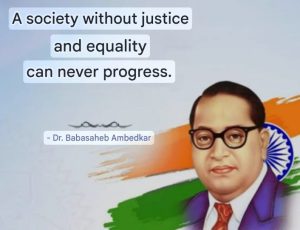 The universally acclaimed great social reformer Dr. Babasaheb Ambedkar was the only scholar among the world’s scholars who had a profound and practical understanding, based on study and direct experience, of the powerless, oppressed, deprived, and victimized citizens and women of India and the world.
He emphatically told the British leaders who granted India independence that it was essential to liberate the Shudra and Ati-Shudra men and women of India from the clutches of the upper castes and that it was absolutely necessary to grant them various rights according to the law.
Similarly, it was important to provide legal recognition to various measures for their upliftment. Only then will the Shudras and Ati-Shudras, who were slaves of the upper castes in India—that is, today’s OBCs, SCs, STs, minorities, and other social groups, along with all men and women—be able to uplift themselves, improve their lives, understand themselves, support each other, eliminate discrimination from their minds, respect each other, remove the stubborn feelings of injustice and oppression from their hearts based on the principle of equality, behave justly, and achieve intellectual, economic, and other forms of progress. They will struggle and contribute to the upliftment of women and men in society and the country. This was the noble purpose and farsighted vision of Dr. Babasaheb Ambedkar, the architect of India, regarding the men and women of India.
Therefore, he clearly stated that the country should have an inclusive and excellent Constitution, and that this Constitution should grant special rights to all men and women of this country, and that legal measures for their upliftment should be included in the Constitution.
He also informed the national leaders and learned dignitaries that Independence Day and Republic Day should be celebrated with great enthusiasm as national festivals in India.
“Independence Day means a country and its men and women freed from British rule…” while, “…Republic Day means the various types of freedom, freedom of expression, and rights granted to all men and women of this country according to the Indian Constitution, by rejecting the oppressive and unjust laws based on Manusmriti and the discriminatory practices of religious texts.
It also represents the ideological rights granted to express the determination to overcome challenges such as poverty, unemployment, and inequality by adhering to the principles of the Constitution.
January 26th, our Republic Day! This day is a golden page in the history of our country, the day our Constitution came into effect and India emerged as a sovereign, socialist, secular, democratic republic.
On this very day, January 26th, in 1950, the Constitution drafted by Dr. Babasaheb Ambedkar and his colleagues was implemented.
This gave us ‘a government of the people, by the people, and for the people,’ that is, democracy. This day reminds us of the sacrifices of many and the foresight of great leaders.
Republic means not just freedom, but also an awareness of our responsibilities. Our country still faces many challenges such as poverty, unemployment, corruption, and inequality. To overcome these, we all need to work together, upholding the principles of equality and justice enshrined in the Constitution.
Let us all together build a strong, developed, and golden India. Let us build an India where every citizen receives equal rights and opportunities.
The fundamental principles of the Constitution are: liberty, equality, fraternity, and justice. Today’s challenges are poverty, unemployment, pollution, and inequality.
Republic Day is a golden day, a day of joy for you and me, a day of national glory, pride, and enthusiasm. It is also a day of justice for us.
January 26th, our ‘Republic Day,’ is a favorite national festival for all of us. Since 1950, every year on this day, we all celebrate this day throughout the country as ‘Republic Day’ or ‘Ganatantra Divas’.
India is a democratic nation. That is, it is ‘a government of the people, for the people, and by the people.’ The country gained independence, and we were freed from the shackles of British rule. Moreover, a regime that grants people the right to live with humanity was established. The foundation of all this is the Constitution of India!
After India gained independence, creating a constitution that would give the country a new shape and direction was a major challenge. Finally, this responsibility was entrusted to Bharat Ratna, the world-renowned scholar Dr. Babasaheb Ambedkar, and he fulfilled this responsibility through immense hard work and profound philosophy.
On January 26, 1950, the newly independent India adopted the Constitution, ushering in a new era of democracy.
Democracy means a government of the people, by the people, and for the people. In short, from this day onwards, the Indian people received the right to govern the country.
The main objectives of the Indian Constitution are to establish justice, liberty, equality, and fraternity; to establish India as a sovereign, socialist, secular, democratic republic; to define the rights and duties of citizens; and to build a strong, stable, and integrated nation, which are clearly stated in the Preamble of the Constitution.
India is independent of any external control and can make its own decisions. Eliminating social and economic inequality and providing equal opportunities to all, and ensuring that the country and the states have no official religion and that all religions are treated with equal respect, are the primary duties of the Government of India and the state governments within India.
The Indian Constitution has ensured social, economic, and political justice. The Indian Constitution has granted every citizen of India the freedom of thought, expression, belief, faith, and worship.
Providing equality before the law and equality of opportunity, and fostering a sense of brotherhood among all citizens are the paramount duties of the Government of India and the state governments, so that everyone feels they are part of the same family, not only in India but also in the world. Defining the fundamental rights and duties of citizens. Defining the structure, powers, and procedures of the executive, legislature, and judiciary. Maintaining the unity and integrity of the country is the paramount duty of all those in power and all government and semi-government officials and employees.
The significance of Republic Day is unparalleled for all men and women in this country. Because from the very first Republic Day, the Indian Constitution granted equal rights to all men and women in this country, protected all men and women, and opened up avenues for all kinds of advancement and progress.