
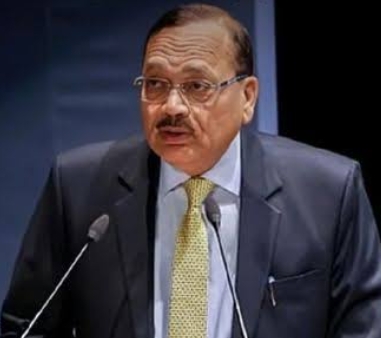
Pradeep Ramteke
Editor-in-Chief
Justice Suryakant has reached India and the world with some judgments and corruption charges. Although he is known for not judging by caste or religion but by staying within the framework of the Constitution, the corruption charges against him remain a mystery. At the same time, the assets worth crores of rupees owned by him and his family members are eye-catching.
But, the citizens of India expect him to judge according to the law without any pressure and with the noble intention of protecting the citizens of the country.
India is a diverse religious and cultural country and is socially divided along caste lines. Therefore, it is the duty of the people-appointed government to protect the culture and rights of all citizens within the country.
However, since the people-appointed governments in India are terribly addicted to casteism, the same people-appointed governments are seen committing injustice and atrocities on citizens of many religions and castes on the basis of discrimination.
At the same time, the central government has trampled on the rights of Indian citizens in the name of privatization and suppressed democracy and citizens.
If the people-appointed governments are discriminating and denying the rights of citizens, it is the job of the court to bring the heads of such governments to justice.
Since Justice Suryakant has been in office as the Chief Justice of the country for 1 year and 3 months, the poor citizens, laborers, farmers, unemployed, women, girls, youth, students and students are of the opinion that he should protect the citizens and democracy of this country.
“I will change my life,” he had a burning ambition. He is now going to become the Chief Justice of the Supreme Court of India. He may have changed or shaped himself according to his ambition. “But, if he delivers justice within the framework of the Indian Constitution, he can shape a bright future for the citizens of India.”
The Department of Justice of the Law Ministry has issued a notification appointing Justice Suryakant as the 53rd Chief Justice of India (CJI).
Justice Suryakant will take charge as the Chief Justice on November 24. He will succeed the incumbent Chief Justice B.R. Gavai, who will relinquish office on November 23. Justice Suryakant will hold this post till February 9, 2027.
Justice Suryakant was the youngest of five siblings, having one sister and four brothers. He was born on February 10, 1962 to Shashi Devi, a housewife, and Madan Gopal Shastri, a government school teacher. Poti was born in Hisar, Haryana.
After completing his bachelor’s degree from the Government Postgraduate College, Hisar in 1981 and his law degree from Maharshi Dayanand University, Rohtak in 1984, Justice Suryakant became the first lawyer in his family.
As per his father’s wishes, instead of pursuing a postgraduate degree in law, he started practicing law in the courts in Hisar. In 1985, he moved to Chandigarh to practice law in the Punjab and Haryana High Court, where he is said to have specialized in constitutional, service and civil matters.
But the corruption allegations leveled against him while he was a judge and the failure to investigate him in these allegations have created an ambivalence in the minds of Indian citizens.
Whether Justice Suryakant’s tenure as the Chief Justice will be within or outside the framework of the Indian Constitution will be determined by his actions and procedures, his duties and his judgments….
But in India, setting aside the Constitution, some emotional It cannot be denied that the principles of democracy, which are for the benefit of all citizens, have not yet taken deep root in the minds of the citizens of India.